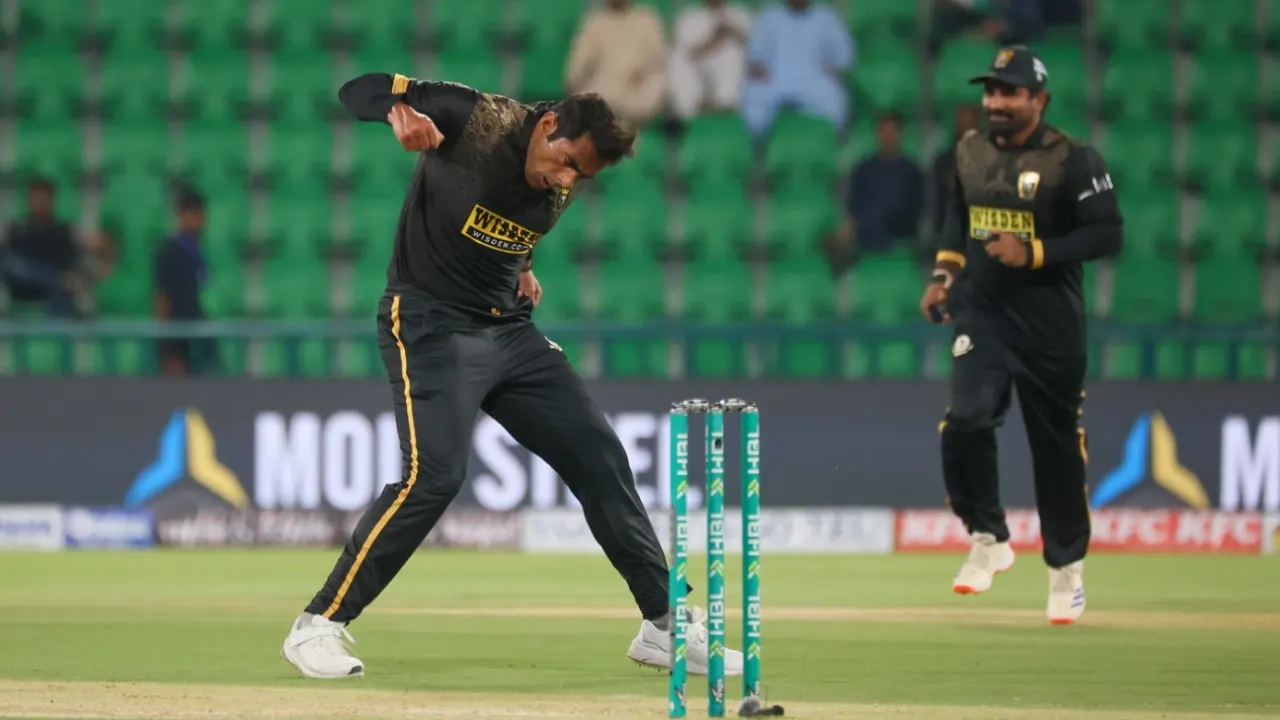
How a debut franchise’s disciplined bowling attack and two electrifying fifties dismantled a former champion in one of PSL’s most complete playoff performances
On a warm Lahore evening at Gaddafi Stadium, with the Eliminator 1 stakes unforgiving — win or go home — Hyderabad Kingsmen confirmed what five consecutive late-season wins had whispered: this is no tourist franchise finding its feet. The 8-wicket demolition of Multan Sultans, chasing down 160 with a staggering 28 balls to spare, was not merely a victory. It was a declaration of arrival, delivered in the unmistakable language of clinical sport.
The final scoreline — Multan Sultans 159/9 (20 overs), Hyderabad Kingsmen 162/2 (15.2 overs) — flatters neither the complexity of what Hyderabad executed nor the scale of Multan’s structural collapse. To understand the full architecture of this result, one must begin where Hyderabad did: with the toss, and a bowling decision that proved visionary before a ball had been bowled.
The Captain’s Gamble That Wasn’t a Gamble
When Hyderabad won the toss and elected to bowl, a certain strain of cricketing orthodoxy might have recoiled. Put your opponents in on a knockout night, under lights, with the pressure of the chase ahead? The conventional wisdom in T20 cricket — particularly in Pakistan, where dew has increasingly turned second innings into a lottery — has long favoured batting first. Hyderabad’s leadership rejected the convention with the cool resolve of a side that trusts its bowlers.
That trust was repaid in full.

Multan Sultans, who boast one of the most star-studded batting line-ups assembled under the PSL franchise model, were reduced to a posture of quiet desperation within four overs. The openers, Sahibzada Farhan (15 off 12) and Steve Smith (13 off 10), departed in the third and fourth overs respectively — the latter caught at mid-off off Mohammad Ali’s probing away-movement, the former trapped by Akif Javed after a promising if brief cameo. The top order’s departure was not catastrophic in itself; it became so because of what unfolded next: four wickets fell for barely 23 runs before the sixth over had concluded, leaving the middle order to bail out a scorecard that read, at its worst moments, like a weather forecast for disaster.
Bowling with Brains: Hyderabad’s Attack Dismantles the Sultans
The narrative of PSL playoff bowling is often defined by one exceptional spell — a Naseem Shah burst, a Shaheen Afridi moonshot delivery. What made Hyderabad’s effort in the Eliminator 1 different was its collectivity, a rotating cast of wicket-takers operating within a coherent and suffocating plan.
Akif Javed (2/30 in 4 overs) set the tone from the opening exchanges, mixing genuine pace with a scrambled-seam length that denied the Multan top order any easy width to work with. He accounted for Sahibzada Farhan with a delivery that moved late and found the inside edge via Saim Ayub’s sharp hands at mid-on — a caught-and-bowled in everything but name. When Akif returned in the 12th over to dismiss Mohammad Nawaz for 18, he extinguished the last realistic hope of a competitive partnership outside of Shan Masood’s heroic rearguard.
Hunain Shah (2/31 in 4 overs) was the pick for sheer wicket-taking significance. His removal of Josh Philippe via leg-before in the fifth over — the Australian wicket-keeper arriving to great expectations — confirmed Multan’s powerplay was beyond salvage. His second wicket, Peter Siddle bowled through the gate in the 16th over, was bowling at its most psychologically precise: a fuller delivery angled into the stumps just as the tail threatened a late flourish.
Mohammad Ali (2/34 in 4 overs) embodied the Hyderabad bowling philosophy most completely — economy and penetration in the same package. His dismissal of Steve Smith in the third over, catching the Australian’s attempted drive through the off-side, reset the match’s centre of gravity. His second scalp, Mohammad Imran Randhawa, was equally compact: bowled through a gate that had not been shut since the first over.
Then there was Saim Ayub (1/23 in 4 overs) — economy rate 5.75, the best of the innings — deployed with the craft of an experienced tactician despite his youth. The left-arm angle into the right-handers created doubt and hesitation; his four overs were a masterclass in conceding nothing, allowing the faster bowlers to attack at the other end.
Glenn Maxwell (1/28 in 3 overs) contributed Arafat Minhas via leg-before, and while Maxwell’s economy was slightly elevated as the innings progressed, his first over — three runs, three dot balls — was an exercise in precision at the heart of the batting powerplay.
Multan Sultans Bowling Scorecard — Eliminator 1
| Bowler | Overs | Runs | Wickets | Economy |
|---|---|---|---|---|
| Akif Javed | 4 | 30 | 2 | 7.50 |
| Hunain Shah | 4 | 31 | 2 | 7.75 |
| Mohammad Ali | 4 | 34 | 2 | 8.50 |
| Saim Ayub | 4 | 23 | 1 | 5.75 |
| Glenn Maxwell | 3 | 28 | 1 | 9.33 |
| Hassan Khan | 1 | 11 | 0 | 11.00 |
Five different bowlers taking wickets in an eliminator is not coincidence — it is system. Hyderabad’s coaching staff built a bowling attack capable of taking wickets in phases, sustaining pressure across twenty overs, and — crucially — avoiding the two or three expensive overs that so often allow a middle-order counter-attack to rescue a struggling batting innings.
Shan Masood: The Lone Vigil That Kept Multan in the Match
It would be dishonest not to acknowledge, amid Hyderabad’s excellence, the extraordinary innings played by Multan’s captain. Shan Masood’s 69 not out off 46 balls — four fours, four sixes, strike rate 150 — was the kind of innings played by someone who has absorbed the specific loneliness of holding a crumbling innings together, who has come through adversity in county cricket, international Test cricket, and franchise formats alike.
Masood was at the crease from the fourth over, after Josh Philippe’s brief stay ended in the fifth, and he simply did not stop. His acceleration was calculated: 12 runs from his first 16 balls as he assessed the scale of the task around him; 57 runs from his subsequent 30 as he threw caution to the evening breeze. Three of his four sixes arrived in the final five overs. His ninth-wicket partnership with Faisal Akram yielded 34 runs; his final unbroken stand with Mohammed Ismail added 11. Without him, Multan post barely a century.
Yet Shan Masood’s innings is, in a sense, the story of Multan’s problem in miniature. A captain should not need to score 69 out of 159. The systemic failure — nine wickets lost while Masood watched from the non-striker’s end more often than any Pakistan captain should — reflects a batting fragility that has haunted the Sultans beyond the comforting statistics of their regular-season finishes. Steve Smith (13), Josh Philippe (6), Ashton Turner (9), Mohammad Nawaz (18): these are names that should, collectively, construct a platform. Instead they built a series of brief cameos that Masood was left to narrate into something approaching coherence.
The lesson for franchises is uncomfortable but necessary: overseas recruitment that supplies brand value without compounding batting depth is an expensive luxury in elimination cricket. When Philippe departs for six and Smith for 13 in back-to-back overs during an Eliminator, the investment calculus becomes inescapable.
The Chase: Maaz Sadaqat and the Language of the New Pakistan
If Hyderabad’s bowling was the tactical masterpiece, their batting was the emotional spectacle — the kind of performance that reminds you why T20 cricket, at its finest, retains an almost theatrical capacity to astonish.
Maaz Sadaqat’s 64 not out off 33 balls earned him the Player of the Match award and deserved rather more than that. Four fours, four sixes, a strike rate of 193.94 — the numbers are arresting, but they do not capture the maturity with which a young batter navigated the chase. Sadaqat played no reverse sweeps born of ego, no scoops that required the luck of the boundary ropes. He hit straight, hit long, and hit often. His innings had the quality that separates the talented from the authoritative: he always looked like he knew what he was doing.
Usman Khan’s 64 off 35 balls (eight fours, three sixes, strike rate 182.86) was the counterweight — more muscular, more wristy through the leg side, more inclined to take on the short ball with an uppish pull that kept finding the stands. Together, Sadaqat and Usman constructed a second-wicket partnership of 102 runs from just 53 balls — the axis upon which the entire chase pivoted.
For Multan’s bowlers, the arithmetic was irretrievable almost from the moment it began. Peter Siddle gave away 31 from three overs at economy rate 10.33. Mohammad Nawaz went for 19 from a single over. Only Faisal Akram (6.00) and Mohammad Imran (10.00) showed any capacity to contain, but containment is irrelevant when the required run rate has already been reduced below six.
Marnus Labuschagne’s 11 at the top before edging Muhammed Ismail to Sahibzada Farhan at first slip was the only interruption to Hyderabad’s sprint, and even that wicket felt incidental in a chase that never seriously wobbled.
Hyderabad Kingsmen Batting — The Match-Defining Partnership
| Partnership | Wicket | Runs | Balls | Run Rate |
|---|---|---|---|---|
| Maaz Sadaqat + M. Labuschagne | 1st | 18 | 12 | 9.00 |
| Maaz Sadaqat + Usman Khan | 2nd | 102 | 53 | 11.55 |
| Maaz Sadaqat + Saim Ayub | 3rd | 42* | 27 | 9.33 |
The Turnaround Story: From Struggling Debutants to Playoff Contenders
Hyderabad Kingsmen’s journey through PSL 2026 is one of the tournament’s defining narratives, and it deserves more analytical attention than it typically receives in the daily cycle of match previews and scorecards.
The franchise, one of the league’s newest additions, opened its PSL campaign with a sequence of early losses that invited dismissal. The commentary reflex — that new franchises need a season to find their feet, that talent must be assembled and then understood before it performs — was applied liberally and not without justification. But Hyderabad’s coaching staff and leadership made adjustments that more experienced franchises failed to: they identified and backed emerging local talent over the reliable comfort of overseas signings, they built a bowling system rather than relying on individual brilliance, and they trusted process over pedigree.
The result was five wins in their last six league games — a form trendline that would have been the envy of any franchise in the competition. That they entered the playoffs with momentum, rather than merely qualification, may prove to be their most significant competitive advantage.
The economic and institutional significance of this trajectory extends beyond cricket. Hyderabad’s emergence as a franchise city in the PSL represents a deliberate effort by the Pakistan Cricket Board (PCB) to decentralise the league’s footprint beyond Karachi, Lahore, and Islamabad — the three traditional power centres of Pakistani urban life. A successful Hyderabad franchise generates local commercial ecosystems, creates broadcast markets, and — perhaps most importantly for the long-term health of the sport — cultivates domestic fan communities in cities that have historically produced cricketers without producing cricket culture at the franchise level.
Multan’s Structural Problem and the Overseas Dependency Question
The broader PSL ownership and management community will study Multan’s elimination with the attention it deserves. The Sultans are no stranger to trophies — their two PSL titles represent genuine excellence — but this season exposed a structural vulnerability that title wins can temporarily obscure.
When your best innings in an Eliminator comes from your captain, batting at number four, in a one-man rescue operation for a side bowled out for 159, the question of batting cohesion demands a frank audit. Multan assembled an enviable collection of overseas names: Steve Smith, Josh Philippe, Ashton Turner, Peter Siddle. In theory, this represents experience, strike-rate, and batting depth. In practice, four of those five contributed a combined 37 runs in a match that required 160.
The PSL’s overseas player regulations, designed to balance international marquee value with local talent development, create an implicit bargain: franchise owners pay premium fees for overseas stars on the understanding that those players will deliver in pressure moments. When the pressure moment of an Eliminator arrives and the overseas contingent falls across consecutive overs, the bargain has not been honoured — regardless of what those players contributed in the league phase.
This is not a critique unique to Multan, nor to Pakistan cricket. The Indian Premier League faces identical tensions; the Big Bash has grappled with them for years. But the PSL, precisely because it remains in a phase of accelerating growth — broadcast revenues rising, international viewership expanding, potential new markets opening across the Pakistani diaspora in the United Kingdom, Canada, and the Gulf — cannot afford to allow franchise models to calcify around the star-overseas template. Hyderabad’s alternative model, centred on Maaz Sadaqat and a domestically-developed pace attack, offers a compelling counter-argument.
Maaz Sadaqat and Usman Khan: Pakistan’s Next-Generation Blueprint
Of the many things this Eliminator produced, perhaps the most durable is the profile it gave two young Pakistani batters to a national audience during a high-stakes playoff.
Maaz Sadaqat arrived in PSL 2026 as a name for the analytically-minded to track on domestic scoreboards — a player whose numbers in first-class and List A cricket had begun to justify the quiet excitement generated among selectors and coaches. The Eliminator provided the pressure-test format in which reputations are either confirmed or exposed. Sadaqat passed every element: the composure to absorb early wickets, the intelligence to accelerate when conditions demanded, the temperament to go deep into a chase without forcing the issue.
Usman Khan’s development has followed a somewhat different path — a power-hitter template that the Pakistan batting order has sought across formats for a decade — but his innings in the Eliminator had a technical quality that sometimes escapes the highlight reel. His ability to hit through mid-on without losing shape under pace, to play the short ball early in the innings when the bowlers were still searching for pressure, suggested a player who has invested time in understanding his own game, not merely his instincts.
Together, they represent something Pakistan cricket has long said it sought and often failed to consistently produce: high-quality, technically literate, psychologically mature young batters ready for the largest stages. Whether national selectors are watching with the urgency the situation merits is, frankly, a separate question — and an uncomfortable one.
The Soft Power Dimension: PSL, Cricket, and Pakistan’s International Narrative
No analytical exercise about PSL 2026 is complete without acknowledging the broader canvas on which the league operates. Pakistan cricket exists at the intersection of sport and geopolitics in ways that few cricketing nations must navigate: questions of hosting international fixtures, bilateral diplomacy with India, the presence of foreign players in a security environment that still generates cautious headlines in Western newsrooms.
Against this backdrop, the PSL’s continued capacity to attract players of the calibre of Glenn Maxwell and Steve Smith, to fill the stands at Gaddafi Stadium for a midweek Eliminator, and to generate digital viewership numbers that place it among the fastest-growing T20 leagues globally, constitutes genuine soft power. The stadium atmosphere in Lahore for this match — warm, loud, invested — was the kind of image that travels via broadcast and social media to Pakistani diaspora communities worldwide and to cricket administrators in London, Dubai, and Sydney evaluating bilateral schedules.
Hyderabad’s emergence only amplifies this. A competitive, geographically diverse league — one where a newly-minted franchise from a city not previously associated with franchise cricket can eliminate a former champion — is precisely the story that the PCB needs to tell, and that foreign broadcasters and investors need to hear.
Qualifier 2: Hyderabad vs. Islamabad United — What Awaits
Hyderabad Kingsmen now face Islamabad United in Qualifier 2, with a place in the PSL 2026 final against Peshawar Zalmi at stake. The matchup is, on paper, the most demanding test the debutant franchise could receive: United are PSL’s most decorated franchise, with a culture of playoff performance that is almost unmatched in Pakistani franchise cricket.
But the parameters of this Eliminator should give United’s coaching staff pause. A bowling attack that takes wickets in rotation, across phases, across bowling types, is significantly harder to plan against than one reliant on one or two match-winners. Hyderabad’s ability to bowl teams out — not merely restrict them — creates a ceiling for opponents’ scores that batting depth alone cannot reliably overcome.
Maaz Sadaqat’s form, in particular, will be the most watched statistical variable going into Qualifier 2. Opening batters who score 64 not out off 33 balls in an Eliminator do not tend to lose their timing overnight. If Sadaqat carries that form, and Usman Khan backs him with similar authority, the required run rate in any scenario becomes a secondary concern.
The broader PSL story of 2026, whatever its final chapter, has already been enriched by Hyderabad’s improbable, disciplined, and ultimately convincing ascent. In a tournament designed to surface talent and tell stories, the Kingsmen have offered both in abundance.
Key Match Statistics
Multan Sultans — Batting
| Batter | Runs | Balls | SR | Fours | Sixes |
|---|---|---|---|---|---|
| Shan Masood* | 69 | 46 | 150.00 | 4 | 4 |
| Sahibzada Farhan | 15 | 12 | 125.00 | 2 | 0 |
| Steve Smith | 13 | 10 | 130.00 | 2 | 0 |
| Mohammad Nawaz | 18 | 19 | 94.74 | 3 | 0 |
| Ashton Turner | 9 | 7 | 128.57 | 1 | 0 |
| Peter Siddle | 9 | 8 | 112.50 | 1 | 0 |
| Josh Philippe | 6 | 4 | 150.00 | 1 | 0 |
Hyderabad Kingsmen — Batting
| Batter | Runs | Balls | SR | Fours | Sixes |
|---|---|---|---|---|---|
| Maaz Sadaqat* | 64 | 33 | 193.94 | 4 | 4 |
| Usman Khan | 64 | 35 | 182.86 | 8 | 3 |
| Saim Ayub* | 15 | 15 | 100.00 | 0 | 0 |
| Marnus Labuschagne | 11 | 9 | 122.22 | 2 | 0 |
Player of the Match: Maaz Sadaqat (64* off 33, 2/4 bowling)
Discover more from The Sport Star
Subscribe to get the latest posts sent to your email.