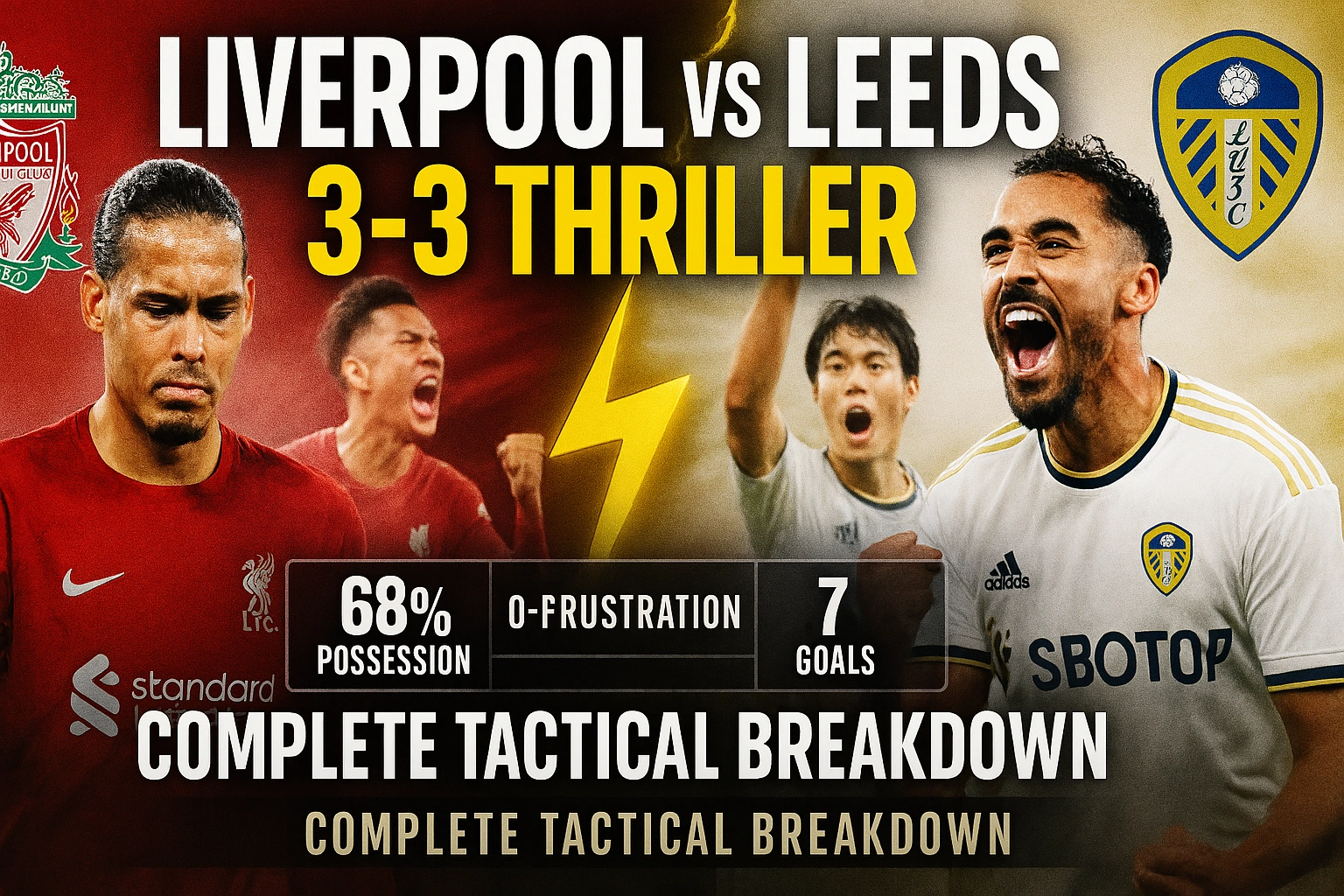
When Champions Can’t Close Games and Underdogs Won’t Stay Down
The crisp air at Anfield on New Year’s Day 2026 felt heavy with frustration. Liverpool, the reigning Premier League champions, had just endured their third consecutive failure to find the back of the net at home, drawing 0-0 with relegation-threatened Leeds United. For Arne Slot’s men, it was a bitter way to ring in the new year—dominant yet toothless, creating chances but lacking the clinical edge that defines champions.
This stalemate stood in stark contrast to their previous meeting just 26 days earlier at Elland Road, where Leeds fought back dramatically to earn a 3-3 draw after Liverpool twice surrendered leads. Together, these two fixtures paint a compelling portrait of a Liverpool side in crisis and a Leeds team scrapping for survival with every ounce of energy they possess.
The December Thriller: When Liverpool’s Defense Collapsed Under Pressure
Let’s rewind to December 6, 2025, when the Yorkshire faithful at Elland Road witnessed one of the season’s most pulsating encounters. Leeds substitute Ao Tanaka’s 96th-minute equalizer sent shockwaves through the stadium and handed Liverpool another devastating blow in what had become a nightmare stretch of form.
The match narrative seemed straightforward at halftime—a goalless stalemate with Liverpool controlling 66 percent possession but struggling to break down Leeds’ disciplined 5-3-2 low block. Daniel Farke’s tactical setup was crystal clear: pack the central channels, force Liverpool wide, and hit them on the counter.
Ekitike’s Double: A False Dawn for the Reds
The second half exploded into life within minutes. Hugo Ekitike struck twice in quick succession, first tapping home from a Conor Bradley cross, then curling in a second to seemingly put the game beyond Leeds’ reach. For the young French striker, it marked his first goals in eight games—a desperately needed confidence boost.
But Liverpool’s Achilles heel reared its ugly head once again. The reigning champions have thrown away leads with alarming regularity this season, and this match would become the fourth time they’d surrendered a two-goal advantage.
The Comeback: Farke’s Substitutions Change Everything
The turning point came in the 73rd minute. Ibrahima Konate’s rash challenge on substitute Wilfried Gnonto led to a penalty after VAR intervention—a moment of individual madness that would prove catastrophically expensive. Dominic Calvert-Lewin, enjoying the purple patch of his career with goals in six consecutive games, stepped up and dispatched the spot-kick past Alisson with authority.
The psychological shift was immediate. Leeds smelled blood, and their fans roared them forward. Just two minutes later, substitute Brenden Aaronson played a clever pass to Anton Stach, who cut inside confidently and finished at the near post to level the score at 2-2. Elland Road had transformed into a cauldron of noise and belief.
Farke’s triple substitution at the 65-minute mark—bringing on Aaronson, Tanaka, and Gnonto—had completely altered the dynamic. Fresh legs exploited Liverpool’s tired midfield, and suddenly the defending champions looked like the team fighting relegation.
Szoboszlai’s Reprieve and Tanaka’s Heroics
Dominik Szoboszlai thought he’d rescued Liverpool in the 80th minute with a composed finish after smart interplay with Ryan Gravenberch, but this Leeds side has developed an admirable refusal to accept defeat. As the clock ticked into the sixth minute of stoppage time, a corner swung into the Liverpool box found its way to the far post where Tanaka thundered home the equalizer—his second dramatic late goal in as many home games.
The statistical breakdown tells a fascinating story: Liverpool enjoyed 68.3% possession and registered 19 shot attempts to Leeds’ four, yet both teams found the net three times. It epitomized Liverpool’s season—territorial dominance without defensive solidity or clinical finishing.
New Year, Same Problems: The Anfield Stalemate
Fast forward to January 1, 2026, and the script had changed but the underlying issues remained. At Anfield, with Liverpool enjoying another overwhelming 69 percent possession advantage, Slot’s side created chances but lacked conviction.
Tactical Setup: Slot’s Calculated Changes
Slot made three alterations from the Boxing Day victory over Wolves. Conor Bradley, Andy Robertson, and Dominik Szoboszlai returned to the starting XI, with Jeremie Frimpong pushed into an advanced right-wing role to compensate for Mohamed Salah’s continued absence at the Africa Cup of Nations.
Leeds, meanwhile, rotated smartly. Farke rested the in-form Calvert-Lewin from the start—a calculated gamble designed to keep his star striker fresh for the upcoming Manchester United derby. Lukas Nmecha led the line instead, with the understanding that Calvert-Lewin could be introduced as an impact substitute.
Dominant but Blunt: Liverpool’s Attacking Woes
The home side generated 1.96 expected goals (xG) according to advanced metrics, with Ekitike accumulating 0.78 xG individually—clear evidence that Liverpool fashioned quality chances. The French forward glanced a header wide from an excellent Frimpong cross in the first half, while captain Virgil van Dijk somehow missed the target with a free header from a corner in the second period.
Leeds goalkeeper Lucas Perri made four crucial saves, denying Liverpool time and again. His performance embodied Leeds’ defensive resilience—organized, disciplined, and willing to throw bodies on the line.
The Calvert-Lewin Factor: Leeds’ Not-So-Secret Weapon
One constant thread through both matches was the impact of Dominic Calvert-Lewin. The former Everton striker has enjoyed a remarkable renaissance at Elland Road, scoring seven goals in six Premier League appearances for Leeds—a run of form that has single-handedly kept their survival hopes alive.
In the December encounter, his penalty conversion was cool and composed, demonstrating the confidence of a striker in prime form. In the January rematch, Calvert-Lewin had a goal disallowed for offside soon after coming on as a substitute—agonizingly close to becoming the match-winner.
His physical presence, intelligent movement, and ruthless finishing have given Leeds a focal point in attack that they’ve lacked for years. When you’re scrapping for survival, having a striker who can turn half-chances into goals is worth its weight in gold.
Liverpool’s Defensive Disintegration: The Numbers Don’t Lie
The statistics make grim reading for Liverpool supporters. Liverpool have won just four of their last 15 games across all competitions, a catastrophic run of form for defending champions. Their defensive fragility has become their defining characteristic this season.
Gary Neville’s analysis was damning: “Liverpool’s implosion is real… His team just implodes. You just can’t trust them”. The Sky Sports pundit highlighted how Liverpool repeatedly make critical errors at crucial moments, particularly from set-pieces—Leeds’ equalizers in both matches originated from corner situations.
The integration of summer signing Florian Wirtz has been problematic. While undeniably talented, the German international’s tendency to occupy similar spaces as Liverpool’s other creative players has disrupted the team’s natural flow. In the January fixture, Wirtz was disappointing and was substituted after 66 minutes as Slot sought fresh impetus.
Tactical Analysis: Contrasting Philosophies on Display
Leeds’ Pragmatic Approach
Farke deserves immense credit for devising a system that maximizes his squad’s strengths while protecting their weaknesses. The 5-3-2/3-5-2 hybrid formation compacts space centrally, with wing-backs Jayden Bogle and Gabriel Gudmundsson providing width in both phases.
Leeds held just 35% possession in the first half of the December match while holding Liverpool scoreless, demonstrating the effectiveness of their defensive structure. Ethan Ampadu anchored the midfield with tireless running and intelligent positioning, breaking up play and initiating counters.
The statistics show Leeds’ transformation under this system. Having claimed their first clean sheet since August in the January fixture, they’ve found a formula for frustrating superior opponents.
Liverpool’s Structural Issues
Slot’s 4-2-3-1 formation looks impressive on paper, with Gravenberch and Curtis Jones forming the double pivot, and creative talents like Wirtz, Szoboszlai, and Gakpo operating in advanced positions. However, the system has been plagued by disconnection between midfield and attack.
The absence of Salah removes Liverpool’s most clinical finisher and most dangerous one-on-one threat. While Ekitike offers intelligent movement and link-up play, he lacks Salah’s ruthless instinct in front of goal. The Egyptian’s continued benching—Slot did not bring on Salah when his team needed a goal, prompting a bombshell interview from the forward—has created significant tension within the squad.
Set-Piece Vulnerability: Liverpool’s Fatal Flaw
Both Leeds goals in the January match could have come from corners if Liverpool’s defending hadn’t improved marginally. In December, Tanaka’s equalizer came from a corner, with the ball finding its way to the far post where he finished emphatically.
This vulnerability stems from organizational issues rather than individual inadequacy. Van Dijk and Konate are both imposing aerial presences, yet Liverpool consistently struggles to track runners and secure second balls from dead-ball situations. It’s a coaching issue that Slot must address urgently if Liverpool are to salvage their season.
The Implications: Two Clubs Heading in Opposite Directions
Liverpool’s Title Race Evaporates
Liverpool now sit fourth in the Premier League with 33 points from 19 matches, a staggering 10 points behind leaders Arsenal. For defending champions, this represents a catastrophic collapse. The gap to fifth-placed Chelsea is just two points—Champions League qualification, once a formality, is now genuinely under threat.
Slot faces mounting pressure. Jamie Carragher said Slot needed seven points from games against West Ham, Sunderland, and Leeds to save his job; he mustered only five. The Dutchman’s tactical inflexibility and questionable man-management—particularly regarding Salah—have raised serious doubts about his suitability for the Liverpool hot seat.
Leeds’ Survival Fight Gains Momentum
For Leeds, these four points from six against the defending champions represent a lifeline. Leeds moved three points clear of the relegation zone after the December draw, and the January point extended their unbeaten run to six matches.
Farke, whose position looked precarious before the Chelsea victory, has engineered a remarkable turnaround. The team’s xG numbers have improved, Calvert-Lewin has become one of the league’s most lethal finishers, and the defensive structure has solidified. With winnable fixtures ahead, Leeds suddenly look capable of avoiding the drop.
What’s Next: Critical Junctures for Both Clubs
Liverpool’s fixture list offers no respite. A trip to Fulham awaits, followed by a crucial Champions League knockout tie. Without Salah and with confidence fragile, Slot must find solutions quickly or risk watching the season unravel entirely. The manager’s relationship with key players, tactical flexibility, and ability to shore up the defense will determine whether Liverpool salvages a top-four finish.
Leeds face a different type of pressure—the relentless grind of a relegation battle. Their next match is the huge derby against Manchester United, followed by a testing run of fixtures. Maintaining Calvert-Lewin’s goalscoring form and defensive solidity will be paramount. If they can continue collecting points against direct rivals and occasionally upsetting bigger teams, survival is achievable.
Conclusion: A Rivalry Renewed in Dysfunction and Determination
These two encounters between Liverpool and Leeds United encapsulate everything compelling about the Premier League. One team, burdened by expectation and struggling under the weight of defending their title, repeatedly shoots itself in the foot through defensive lapses and attacking profligacy. The other, written off as relegation fodder, fights with heart, organization, and the belief that nothing is decided until the final whistle.
Liverpool’s 1.51 xG in the January fixture against Leeds’ minimal threat tells one story—territorial dominance. But football isn’t played in spreadsheets. It’s contested in moments of individual brilliance, collective determination, and psychological fortitude. On both occasions, Leeds demonstrated superior mental strength, whether clawing back from two goals down or frustrating a superior opponent into submission.
For Liverpool, these results represent more than dropped points—they’re symptoms of deeper structural and psychological issues that won’t be resolved overnight. For Leeds, they’re evidence that pragmatism, passion, and a clinical striker can overcome superior resources.
As the season progresses, both clubs face critical battles—Liverpool for European qualification and credibility, Leeds for Premier League survival. Based on these two performances, predicting the outcome of either fight feels impossible. And that’s exactly what makes the Premier League magical.
What did you think of these Liverpool vs Leeds encounters? Share your tactical insights in the comments below, and don’t forget to subscribe for more in-depth Premier League analysis throughout the season!
Discover more from The Sport Star
Subscribe to get the latest posts sent to your email.