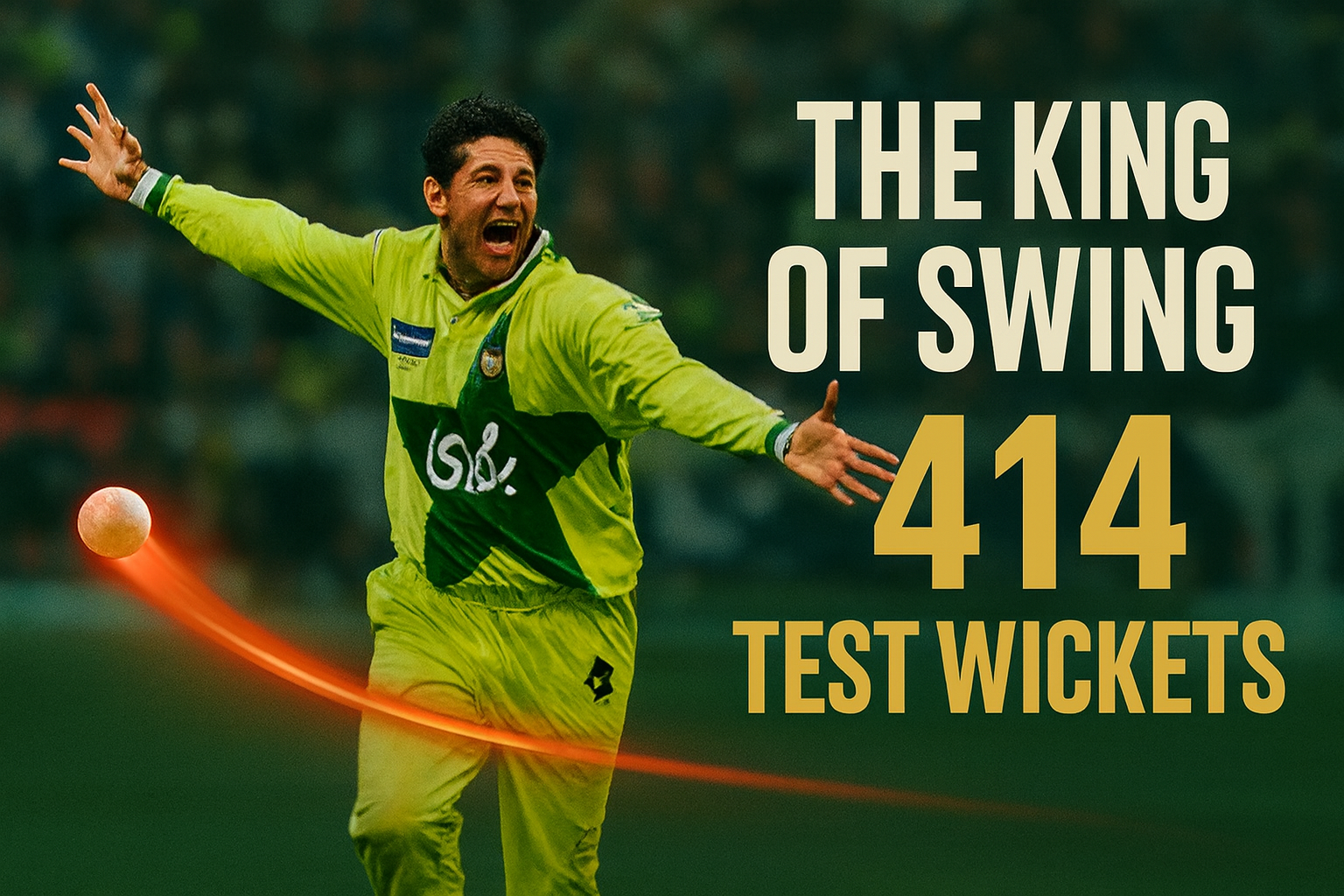
Discover how Wasim Akram’s 916 international wickets and revolutionary reverse swing technique made him cricket’s greatest fast bowler. Stats, insights & legacy analysis.
Melbourne, March 25, 1992. The ball left Wasim Akram’s hand at lightning pace, but it wasn’t the speed that froze Allan Lamb mid-stroke—it was the physics-defying trajectory that followed. Swinging in at chest height, then darting away to kiss the off stump. One ball later, Chris Lewis suffered the same fate. Two deliveries. Two perfect wickets. A World Cup won. These weren’t just cricket balls; they were masterpieces painted with leather and seam, and the artist wielding the brush was about to cement his place as the greatest left-arm fast bowler the game has ever witnessed.
Nearly three decades later, Wasim Akram’s legend continues to grow. As modern fast bowlers like Shaheen Afridi and Mitchell Starc attempt to replicate his magic, one truth becomes undeniable: the Sultan of Swing didn’t just play cricket—he redefined what was possible with a cricket ball in hand.
The Physics of Dominance: Decoding the Unplayable
What made Wasim Akram virtually unplayable wasn’t just one element—it was the devastating combination of pace, swing, control, and unpredictability that left the world’s best batsmen guessing. Standing at the non-striker’s end, you could see the ball’s trajectory. Facing him from 22 yards? That was an entirely different equation.
His action was poetry in motion. A smooth, economical run-up that conserved energy while generating fearsome pace. His wrist position at the point of release was the secret sauce—supple, deceptive, and capable of producing swing in both directions with imperceptible changes. The ball could leave his hand on identical trajectories, yet one would tail in viciously while the next would hold its line and kiss the edge.
But Akram’s true genius lay in his mastery of reverse swing. In the early 1990s, when most bowlers struggled to understand the concept, Wasim had already perfected the art of making an old, scuffed ball behave like a heat-seeking missile. By keeping one side of the ball rough and the other shiny, he could produce late, dramatic movement that defied conventional cricket wisdom. Batsmen accustomed to reading swing in the first few meters were left bamboozled when Akram’s deliveries moved violently in the final moments before impact.
Cricket legend Brian Lara, who faced virtually every great bowler of his era, was unequivocal in his assessment. When asked about standout opponents, he consistently named Akram, acknowledging the Pakistani maestro made him work harder at the crease than anyone else. The West Indian great understood what made facing Wasim so treacherous: you couldn’t settle into a rhythm. A searing yorker at 90 mph could be followed by a slower ball disguised with identical action, then an away-swinging delivery that moved a foot in the air.
Wasim Akram himself once revealed his approach to facing cricket’s elite, stating his mantra was keeping relentless pressure on top batsmen, knowing that dismissing the star player often led to team collapse. It was this tactical intelligence, combined with his technical brilliance, that made him more than just a fast bowler—he was a chess master playing at 90 miles per hour.
His arsenal included the inswinging yorker that became his signature weapon. Delivered from wide on the crease to a right-handed batsman, the ball would start outside leg stump before swinging back dramatically to crash into the base of middle and off. Even when batsmen knew it was coming, they couldn’t stop it. The late dip and swing made it virtually impossible to dig out.
Statistical Supremacy: Numbers That Tell a Champion’s Story
The statistics paint a picture of sustained excellence across two decades. Akram finished his Test career with 414 wickets in 104 matches at an average of 23.62, while in ODIs he claimed 502 wickets in 356 games at 23.52—numbers that placed him in the pantheon of all-time greats.
But raw totals only tell part of the story. Context matters. Akram became the first bowler in cricket history to reach 400 wickets in both Test and ODI formats, a feat that demonstrated remarkable longevity and adaptability. When you consider he achieved this while frequently bowling on flat subcontinent pitches and during an era when batting averages were climbing, the achievement becomes even more impressive.
His economy rate of 3.89 in ODI cricket remains exceptional for a pace bowler, especially one used primarily in the crucial death overs. In an age before T20 cricket transformed limited-overs batting into an all-out assault, Akram was already facing the challenge of containing batsmen in the final overs while also taking wickets. He managed both with aplomb.
Akram’s 25 five-wicket hauls in Test cricket and six in ODIs showcase his ability to dominate innings and change match outcomes single-handedly. His best Test figures of 7 for 119 came against New Zealand at the Basin Reserve in 1994, part of a remarkable series where he captured 25 wickets in just three Tests.
The 1992 World Cup remains the crown jewel in his career. In the final against England, Akram produced an all-round masterclass, scoring 33 runs from 18 balls to propel Pakistan to 249, before claiming 3 for 49 with the ball, including the match-defining dismissals of Allan Lamb and Chris Lewis in consecutive deliveries. His ability to deliver in cricket’s biggest moments separated him from merely great bowlers.
When compared to contemporaries like Curtly Ambrose, Glenn McGrath, and Allan Donald, Akram’s versatility stands out. While Ambrose relied on bounce and accuracy, and McGrath on relentless line and length, Wasim possessed every weapon. He could intimidate with short-pitched bowling, mesmerize with swing, deceive with changes of pace, and destroy with yorkers. This complete skillset made him dangerous in all conditions—seaming English pitches, bouncy Australian tracks, spinning Indian wickets, and flat Pakistani roads.

His record against the best batting lineups of his era speaks volumes. Against Australia, who boasted batting giants like Steve Waugh, Mark Waugh, and Allan Border, Akram claimed 50 Test wickets. Against the West Indies, featuring Brian Lara and a lineup full of attacking stroke-makers, he took 79 Test wickets. His head-to-head battles with these legends became defining moments in cricket history.
Business of Legacy: Building an Empire Beyond the Boundary
Retirement from international cricket in 2003 wasn’t the end of Wasim Akram’s cricket journey—it was merely the beginning of a new chapter. The Sultan of Swing had already established himself as one of cricket’s most recognizable faces, and he leveraged that celebrity status with astute business acumen.
His transition to commentary brought the same insight and charisma he displayed on the field to broadcasting booths worldwide. Whether providing expert analysis for ESPN Cricinfo, Fox Sports, or Sky Sports, Akram’s deep technical knowledge combined with his engaging personality made him a viewer favorite. Unlike many ex-cricketers who struggle to articulate the game’s nuances, Wasim possessed the rare gift of breaking down complex bowling techniques into digestible insights for casual fans while satisfying hardcore cricket enthusiasts.
The coaching circuit welcomed him with open arms. His mentorship of young fast bowlers, particularly in the Pakistan Super League and various Twenty20 franchises, allowed him to share decades of accumulated wisdom. Emerging Pakistani pacers like Shaheen Shah Afridi have openly credited Akram’s guidance as instrumental in their development, ensuring the Sultan’s techniques and philosophy continue influencing new generations.
Brand endorsements flowed naturally to someone with Akram’s stature. From cricket equipment to lifestyle products, his image remained synonymous with excellence and integrity. His appearance at the Pantene Bridal Couture Week 2011 demonstrated his crossover appeal beyond sports, tapping into Pakistan’s entertainment and fashion industries.
Perhaps most significantly, Akram’s economic impact on Pakistan cricket cannot be overstated. His success, combined with that of teammates like Imran Khan and Javed Miandad, transformed Pakistan into a cricket powerhouse and created commercial opportunities that didn’t exist before. Television rights, sponsorship deals, and cricket academies all flourished partly due to the foundation laid by Akram’s generation.
His 2018 involvement with Cricingif as a stakeholder director showed his willingness to embrace cricket’s digital future. Understanding that new generations consume cricket differently, through highlights, GIFs, and social media, demonstrated his forward-thinking approach to staying relevant.
The post-cricket Wasim Akram also became a powerful voice for the sport’s integrity and development. His memoir “Sultan: A Memoir,” co-written with Gideon Haigh, provided candid insights into cricket’s golden era while addressing controversies honestly. This transparency enhanced rather than diminished his reputation, as fans appreciated his authenticity.
Cultural Impact and Modern Relevance: The Swing King’s Enduring Influence
Walk into any cricket academy from Karachi to Kolkata, Sydney to Southampton, and you’ll find young left-arm pacers trying to replicate Wasim Akram’s action. His influence transcends borders, religions, and cricket cultures because he represented something universal: the pursuit of perfection through dedication and innovation.
In Pakistan, Akram’s impact goes beyond statistics. He became a symbol of what the nation could achieve on the world stage. During periods of political uncertainty and economic challenges, Wasim Akram’s performances provided moments of national pride and unity. When he clean-bowled batsmen with those unplayable reverse-swinging yorkers, he wasn’t just winning cricket matches—he was lifting a nation’s spirits.
Today’s fast bowling generation studies his methods religiously. Akram was recognized as the only Pakistani cricketer named in an all-time Test World XI to mark Wisden Cricketers’ Almanack’s 150th anniversary in 2013, a testament to his enduring greatness. When Shaheen Afridi produced a match-winning spell in a crucial T20 World Cup game, commentators immediately drew parallels to Akram’s heroics three decades earlier.
The revolution in T20 cricket has actually enhanced Akram’s legacy rather than diminishing it. Death bowling—the art of bowling accurately under immense pressure in the final overs—has become cricket’s most valuable skill. Wasim pioneered this craft in ODI cricket, developing yorkers, slower balls, and wide deliveries that modern T20 specialists now use as standard tools. Every time Jasprit Bumrah nails a toe-crushing yorker or Trent Boult swings the new ball, they’re executing skills Akram mastered and popularized.
His social media presence keeps him connected with millions of fans worldwide. Whether sharing throwback videos of his greatest wickets or offering technical tips to aspiring bowlers, Akram understands the importance of maintaining relevance in the digital age. His followers don’t just see a retired legend; they engage with an active cricket mind still contributing to the game’s discourse.
For modern athletes across all sports, Wasim Akram’s career offers crucial lessons in longevity and brand building. He demonstrated that excellence on the field creates opportunities off it, but only if athletes invest in developing additional skills—communication, business acumen, and authentic personal branding. His post-retirement success shows that athletic careers are marathons with multiple phases, not sprints that end with retirement.
Cricket coaching methodologies now incorporate principles Akram championed. The emphasis on wrist position for swing bowling, the strategic use of the old ball, the mental game of setting batsmen up—these weren’t mainstream coaching points before Wasim made them essential elements of fast bowling education.
The Eternal Sultan: What Tomorrow Holds for Akram’s Legacy
As cricket evolves with innovations in T20 leagues, franchise cricket, and emerging technologies like ball-tracking and biomechanical analysis, Wasim Akram’s legacy only grows more impressive. Modern fans rewatching footage of his bowling on YouTube express amazement at his skills, often commenting that he bowled deliveries considered cutting-edge today back in the 1990s.
The question isn’t whether future bowlers will match Akram’s achievements—it’s whether the game will produce another cricketer with his complete package of pace, swing, guile, longevity, and clutch performance. In an era of specialization, where bowlers focus on specific formats or phases of play, Akram’s all-format excellence seems increasingly rare.
For young cricketers today, the Wasim Akram story offers a blueprint: master your craft through relentless practice, innovate within your discipline, perform in crucial moments, and build a legacy that extends beyond statistics. It’s about understanding that greatness isn’t just about natural talent—it’s about maximizing that talent through intelligent application and unwavering dedication.
Cricket’s historians will continue debating who was the greatest fast bowler ever. Names like Dennis Lillee, Malcolm Marshall, Glenn McGrath, and Dale Steyn will feature prominently. But when discussing left-arm pace bowling, there’s no debate. Wasim Akram stands alone at the summit—the undisputed King of Swing whose revolutionary approach changed fast bowling forever.
The ball may have stopped swinging from his hand two decades ago, but his influence continues to shape cricket’s present and will define its future. Every inswinging yorker, every reverse-swinging delivery, every young left-armer dreaming of international glory—they all carry forward the legacy of the Sultan who made the impossible look routine.
In the end, perhaps the greatest tribute to Wasim Akram isn’t found in record books or highlight reels, but in every cricket ground worldwide where a young bowler grips a red ball, runs in with dreams in their heart, and tries to make it swing like the maestro once did. That’s immortality. That’s legacy. That’s the King of Swing.
What can today’s athletes learn from Wasim Akram’s journey? Share your thoughts and favorite Wasim Akram moments in the comments below. Subscribe to our newsletter for more in-depth analysis of cricket’s greatest legends.
Discover more from The Sport Star
Subscribe to get the latest posts sent to your email.